
Voicing concerns on overheating, Crisil Ratings on Monday said rising interest rates and liquidity constraints would push down India's GDP growth in the range of 7.9-8.4 per cent in 2007-08.

Ahead of the key meeting called by the steel ministry with the industry captains on Monday to discuss the impact of rising steel imports, companies have raised the issue of cheaper 'substandard' inflows from China, Vietnam, and South Korea, saying they are setting the benchmark for domestic prices and squeezing the profitability of Indian producers.

The imposition of a 100 per cent tariff by the US on imports of branded and patented pharmaceutical products starting October 1 may not significantly hurt Indian drug makers, with Sun Pharma being exposed to some headline risk but with limited earnings impact, according to analysts. Among Indian companies, only Sun Pharma has sizeable sales from patented drugs in the US (about 17 per cent of 2024-25 revenue), HSBC Global Investment Research said in a report.

India's power demand rose 4.5 per cent year-on-year (Y-o-Y) to 143 billion units (BUs) in January, marking the highest consumption for the month since 2010, primarily on the back of severe cold wave conditions across northern and eastern regions of the country.

Mixed views were expressed by top economists on the Reserve Bank of India's (RBI) Monetary Policy Committee's (MPC) decision to hold the repo rate at 5.5% and maintain a neutral stance. While some say the decision was as expected and one more rate reduction is expected this fiscal, there is also a view that rate cut by MPC was warranted given the evolving global situation.

The repo rate cut by 25 basis points by the monetary policy committee (MPC) of RBI announced Friday will give a long-awaited relief on interest rates and also be supportive of economic growth, according to experts. Repo rate is the interest rate at which the RBI lends money to commercial banks.

While demand for sub Rs 50-lakh affordable housing prevails, market players cite increased land rates, escalated construction costs and low margins as key prohibiting factors.

The Indian economy is likely to grow at 7.4 per cent in 2025-26, up from 6.5 per cent in the previous fiscal, mainly on account of better performance of manufacturing and services sectors, as per the government data released on Wednesday.

Ratings firm Crisil said on Wednesday that the uncertainties surrounding the US tariffs might be a new hindrance to capital expenditure decisions in the current financial year. The additional 25 per cent tariff imposed by US President Donald Trump on India for its purchases of Russian oil came into effect on Wednesday, bringing the total amount of levies imposed on New Delhi to 50 per cent.

Supported by strong buoyancy in public sector capital expenditure (capex), growth in infrastructure investment is expected to accelerate in 2025-26 (FY26) compared to 2024-25 (FY25), according to the First Advance Estimates of gross domestic product (GDP) for FY26 released by the National Statistics Office (NSO) on Wednesday.

The net leasing of Grade-A commercial office space in India will stagnate this financial year at 32-34 million square feet, with global uncertainties brewing caution among key tenant categories, according to the latest Crisil Ratings report. Major seven cities in India - Bengaluru, Chennai, Hyderabad, Kolkata, Mumbai Metropolitan Region (MMR), National Capital Region (NCR) and Pune - had Grade-A office space with an operational stock of around 705 million square feet as of March 2023. India's commercial office space is dominated by technology companies, with information technology (IT) and IT-enabled services (ITeS) companies occupying 42-45 per cent of the operational stock.

Retail inflation rose to a three-month high of 1.33 per cent in December 2025 mainly due to higher prices of kitchen essentials, including vegetables and protein-rich items.

The sweeping tariffs proposed across sectors by US President Donald Trump are scheduled to be imposed starting April 2, with most analysts worried about their impact on companies, and in turn the financial markets. Recently, the US administration signaled that it will impose sectoral tariffs on energy, pharmaceuticals, semiconductors, agriculture, copper, and lumber.

IT services firms' revenue growth in the fourth quarter will be affected by macro-driven headwinds, lower working-days, and the fact of the three-month period being low season. Analysts are expecting FY24 growth to be muted. Revenue growth will decline 600-700 basis points to 10-12 per cent for FY24, said a CRISIL Ratings report. The 10-12 per cent growth rate is a fall from the 18-20 per cent expected in FY23 and around 19 per cent growth in FY22, the highest in eight years, said the CRISIL Ratings report.
The rating agency has released the study on its ratings experience in the default and transition ratings of both short-term and structured securities in the country in the last 16 years. The data used for the study covers a period of weakened credit quality (1995-1999) as well as one of improving credit quality (2000-2007).

Ratings are based on the overall exposure to default risk, with regard to timely receipt of payments from the investments the scheme has made.

Crisil Ratings on Wednesday said a broad-based recovery is on for India Inc currently, and upgraded its credit quality outlook to 'positive' from the earlier 'cautiously optimistic'. The rating agency said the credit ratio, which illustrates the number of upgrades to downgrades, rose to over 2.5 times in the first four months of the fiscal, as compared to 1.33 times in the second half of FY21, it said in a statement. The rating agency said it has also done a study of 43 sectors, excluding the financial sector, accounting for 75 per cent of the overall Rs 36 lakh crore in outstanding debt, which shows that the current recovery is broad-based.

The Reserve Bank of India's (RBI's) decision to withdraw the incremental cash reserve ratio (I-CRR) is expected to benefit banks during the festival season. They are likely to increase deposit rates by up to 25 basis points (bps) in select maturity buckets. The rise in demand for funds to cover tax payments and meet quarter-end business targets could influence rate decisions by banks, according to bankers and money market executives.

With discretionary spending still under pressure, the information technology (IT) services industry continued to face an uncertain demand environment in the third quarter of 2025-26 (Q3FY26).
The Credit Rating Information Services of India Ltd (Crisil) has reaffirmed its ratings of three different fund raising programmes of Tata Iron and Steel Company Ltd (Tisco).
CRISIL reaffirms P1+ rating to Nahar CP.

'Sebi's move to cap brokerage charges will help investors by lowering the overall cost of investments.'
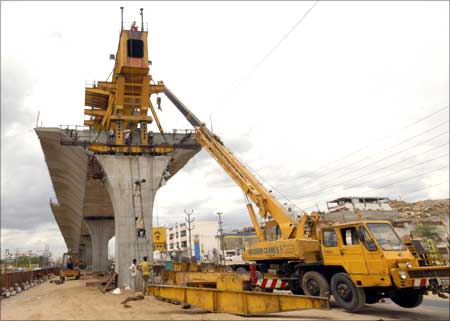
26 out of 80 operational projects are in no position to service debt.
India, the world's fourth largest economy, is set to maintain the 'goldilocks' phase with tailwinds of good growth, low inflation and robust banking performance as well as reform initiatives poised to sustain the economic pace witnessed during 2025.
CRISIL upgrades ratings for IPCL debt plan.

India's top cement producers delivered a solid July-September quarter (Q2) in 2025-26 (FY26), lifted by firmer prices, higher sales volumes, and a favourable base. Seasonal weakness and maintenance outages did dent sequential performance, but the overall picture remained positive - and the road ahead looks steady.
The government on Thursday ruled out giving another extension to various states for unbundling their electricity boards as part of measures to encourage non-government entities in the power sector.

Domestic commercial vehicle sales volume is expected to grow 9-11 per cent in FY24 driven by medium and heavy commercial vehicles and an estimated economic growth of around 6 per cent, rating agency CRISIL said on Monday. Besides, an increased allocation to infrastructure spending in the Union Budget for next fiscal year will support demand, it said. This would be the third consecutive year of growth in the domestic CV industry, according to CRISIL.

The economy is likely to log in a tepid 6 per cent growth next fiscal, in line with the consensus estimates, rating agency Crisil said on Thursday. The agency also sees the economy averaging a growth rate of 6.8 per cent over the next five fiscals. Crisil further said it expects the corporate revenue to log in double-digit rise again next fiscal.

Top real estate developers reported healthy presales growth in the second quarter of FY26, aided by a steady pipeline of new project launches. While overall housing momentum across major Indian cities moderated during the quarter, listed players remained relatively insulated.

Dr Nagesh Kumar, one of the three new MPC members, wanted the MPC to reduce the repo rate by 25 basis points to 6.25%.

Fears of banks' earnings plummeting in a deregulated savings deposit rate regime appear to have gripped investors, with most analysts hinting that profitability may come under pressure due to higher cost of funds amid slowing growth in advances.

Rating agencies Crisil and Icra on Monday revised down their India growth projections for the current fiscal and the second quarter mainly due to the ripple effect of slowdown in global growth and mixed crop output. Crisil downgraded the India growth forecast by 30 bps to 7 per cent while Icra pegged the economic expansion at 6.5 per cent for the second quarter of FY2022-23. "We have revised down our forecast for real gross domestic product growth to 7 per cent for fiscal 2023 from 7.3 per cent, primarily because of the slowdown in global growth that has started to impact our exports and industrial activity.

Revenues from Bangladeshi patients have declined by 30% to 35% in 2024-2025. Bangladesh typically accounts for 70% to 75% of all medical visas issued by India.

India Inc, which had been battered by downgrades, would continue to see rating downgrades, although their severity and intensity might decline, said rating agency CRISIL.

Mahindra & Mahindra plans to manage rare earth magnet supplies through alternative sourcing channels for the next nine months and will pursue 'engineering efforts' to address the raw material shortage situation amid growing product portfolio, according to a senior company executive. The imposition of export restrictions by China on key rare earth magnets has resulted in supply chain bottlenecks, impacting the user industries, including the auto and electronics sectors.

Crisil Ratings on Wednesday projected India's GDP growth at 6.8 per cent in the next fiscal and said the country will become an upper middle-income nation by 2031 with the economy doubling to $7 trillion. In its India Outlook report, Crisil said the Indian economy will take support from domestic structural reforms and cyclical levers and can retain -- perhaps even improve -- its growth prospects to become the third largest economy by 2031. "After a better-than-expected 7.6 per cent this fiscal, India's real GDP growth will likely moderate to 6.8 per cent in fiscal 2025," said the Crisil India Outlook report.
